hillary-black-MLhSNqH_RVc-unsplash-1

6 Ways to Market Your Business

When it comes to marketing your business, there’s more than Meta.

There are so many great options for marketing your business that don’t include Instagram and Facebook. If you’re not using any of them yet, 2024 should be the year to try them.

Email Marketing

Email marketing is one of the most effective ways to market your business. Unlike social media platforms, you’re not at the mercy of ever-changing algorithms. I’ve had fantastic email marketing results with clients over the last few years.

Customers (or potential customers) have given you their email address and permission to drop into their inbox. Email is the perfect platform for more detailed information; social media works best with short-form content. People don’t expect to read long captions along with an Instagram or Facebook post, but when people get emails, they anticipate that more reading might be required.

Email marketing allows you to reward your customers for their loyalty by adding exclusive offers, discounts or early access for email subscribers only. If you don’t have an email list yet, make this a top priority for 2024!

TOP TIP: Don’t spam your subscribers with too many emails; this is a sure way to get them to hit the ‘Unsubscribe’ button!

Blog posts

Blog posts are a great way to market your business. They allow you to give more detail about your products and provide value to your customers (or potential customers). Blog posts also don’t have the same shelf life as social media content, blog posts that are years old can still resurface on search. Blogging is not dead!

Not sure what to blog about? Think about the most frequently asked questions you get and answer them. Really dive into a product; what are the benefits of it, and how can your customers get the best results from using it? If this doesn’t work for your business think about ways you could make this content fit.

An added bonus; Google LOVES fresh content on your website.

A website

Passing on having a website in favour of Facebook or Instagram is a big ‘no-no’. Having your own website puts you in control; you own it and you don’t have to worry about the service being down, or disappearing altogether. If there are ever any server problems your host is contactable and will work to get your site back online asap!

Plus, there is only so much information you can put on a social media platform. Lots of people still want to check out your business through a website.

Video

Like or not, video is here to stay! Making videos for your business doesn’t mean you need to show your face on camera, but video has proven a much more engaging format than static posts.

The great thing about YouTube, should you opt for this, is that Google own it. This means if you use keywords effectively then your videos will come up on Google search.

Start a podcast

Podcasts have had a revival over the last few years and I’m here for it. Podcasts are great for service based businesses; an ideal way to impart knowledge and position yourself as an expert in your field.

Other Social Media Platforms

Sometimes it’s easy to forget there’s more to the world of social media than Instagram and Facebook…but there is!

Pinterest (although not technically a social media platform, but more a visual search engine) remains one of the best options to drive traffic to your website. And TikTok continues to be a popular app with 1 billion global active users and they use it for an average of 90 minutes each day!

Are you currently using any of these methods for marketing your business?

kayleigh-crawford-digital-confident-on-camera

4 Ways to be More Confident on Camera

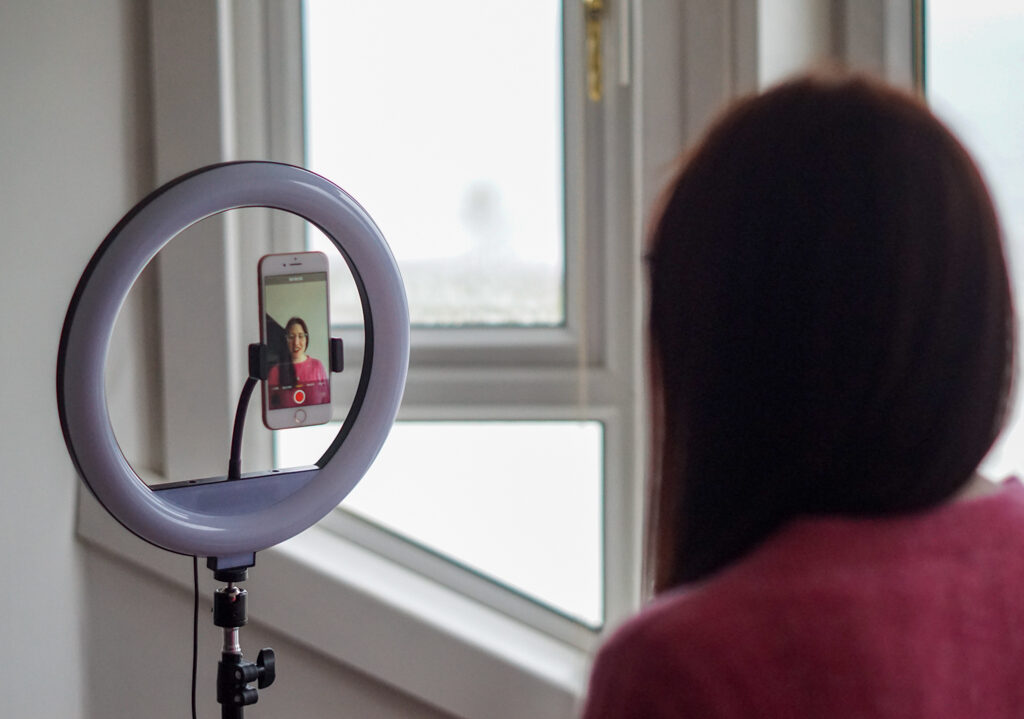
a smartphone is attached to a ring light, the screen is unlocked and is showing an image of a woman with dark hair, glasses who is wearing red lipstick and a pink jumper and smiling. The back of the woman's head is also in the shot, the photo is being taken from behind her

Showing up on video is great for your business!

But my God is it nerve-wracking!? Being confident on camera isn’t something that comes naturally to everyone. When I first started my business I knew talking on camera was important but it was something I really struggled with. Most individuals will scrutinise everything about the way they talk, how certain words are pronounced, facial movements or hand gestures we make. And do you know what? You’re most likely the only person that notices these things. The people watching your video are far more interested in what you’re saying rather than what you look like while you’re saying it.

The good news is, with a bit (or a lot) of practice it is possible to build your confidence on camera and feel happy posting them for the world to see. I have four tips that worked for me, and these can help you too. We’ll have you chatting away on Instagram Stories in no time at all!

Practice filming yourself

To get confident on camera you need to get used to seeing and hearing yourself on video. You can practice by filming on the camera on your phone or laptop and watch them back. These videos don’t have to go anywhere, they can be just for you, to begin with.

Once you feel comfortable with where to look, and start to sound confident talking to no-one, you know you’re ready to post your first public video. I’ll be honest, for me, it took a while to feel comfortable essentially talking to no-one while filming. But we live in a world where people are constantly just talking to the camera on their phone. Younger Millenials and GenZ kids do it without thinking so channel some of their confidence when you’re making your own videos.

Plan what you will talk about

One thing that makes you sound confident on camera is talking like you really know exactly what you’re saying. Waffling, or repetition, makes you sound unsure and can make viewers disengage.

Use a post-it note to jot down talking points and stick it next to your camera. You can even write a script if this would be more helpful. Have it on your laptop screen behind your camera so you can refer to it if you need to.

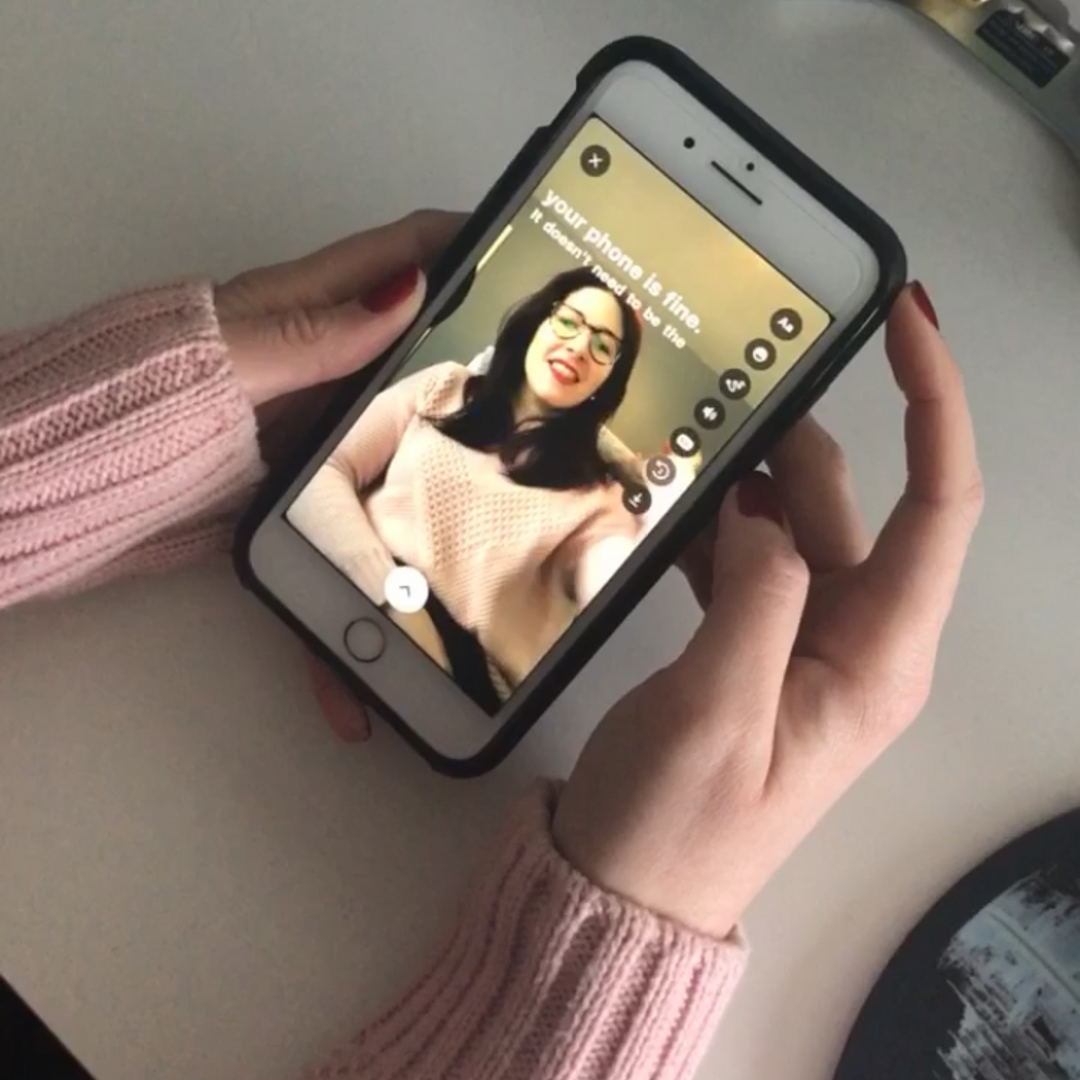
a woman's hands are holding a smartphone, the screen is unlocked and is showing an image of a woman with dark hair, glasses who is wearing red lipstick and smiling. There are closed captions on the screen

Add captions to your videos

Whether you’re posting videos on Instagram Stories, Reels, Facebook or YouTube please, please, please add closed captions to them! There is nothing worse, and more confidence knocking than spending time filming a video or Stories and then having nobody engage with it at all. Closed captions can make or break engagement on videos. I’m really passionate about captioning your videos, I bang on about this all the time, but with good reason.

Captioning video is SO important for a couple of reasons; first up, a lot of people actually watch videos without sound (around 85% of Facebook users), but more importantly, there over 18 million people* in the UK alone who are deaf or have a hearing impairment. Adding closed captions to your videos ensures that the content is accessible and means people aren’t being excluded from enjoying the funny, educational or chatty videos you’re sharing online.

Adding captions can add time when it comes to creating your videos, but it’s worth spending the time to do it. Most platforms now have an option to auto-generate captions. They don’t always pick up accents correctly but don’t worry you can edit the captions before posting.

When you’re uploading a Reel to Instagram, make sure you’ve toggled on “Enable closed captions” under “More options”. This can be found if you scroll to the bottom of the screen when you’re on the screen you add a caption for a new Reel.

Set yourself a challenge

This is what ultimately worked for me when I was trying to become more confident on camera. At the start of 2020, I challenged myself to show up and talk on Instagram Stories at least once a week. Despite 2020 being a weird and unpredictable year, I did pretty well with this challenge and it really did help with my confidence!

If once a week feels too much to start with, how about once a month? Pick a topic to discuss; it could be a new product or service launch, a business update, a Q&A or just a chatty series of Stories to help your followers get to know the face behind the business better!

Have I convinced you to try videos yet?

Showing up and talking on camera is such a personal way to communicate. It encourages responses and engagement on Instagram Stories and on Facebook and allows you to build rapport with people before meeting them in person.

Writing showing the name 'Kayleigh' written in a yellow cursive font

*According to RNID (Royal National Institute for Deaf People)

christin-hume-hBuwVLcYTnA-unsplash

8 Benefits of Blogging for Business

Is a blog needed for your business?

When you run your own business, writing a blog for your website seems like just another thing to add to a never-ending list. It’s something a lot of people don’t have time for. I’ve spoken to lots of business owners who tell me they just don’t have the time. I get it. Blogging can be time-consuming. But there are so many benefits of blogging for your business, it’s worth setting some time aside to do it. 

1. Google loves fresh content

Lots of people think once you have a website built you’re sorted and don’t need to do anything else. Unfortunately, Google has other ideas. The algorithm works to show you relevant pages for your search. Websites that haven’t been updated fall further down the list of search results. 

2. Blogging is content marketing

Content marketing is described as ‘a type of marketing that involves the creation and sharing of online material (such as videos, blogs and social media posts) that does not explicitly promote the brand but is intended to stimulate interest in its products or services’.

Content marketing is basically marketing your business without actually seeming like you’re marketing your business. You don’t need to name your products, all posts don’t necessarily need to be directly about them, but should be aligned with what your business is about. For example, you could be a business selling eco-friendly products and you write a post with eco-friendly tips or easy sustainable swaps. Although you’re not directly talking about your products, you’re discussing values that are at the core of your business and providing value to your customers. 

3. Opportunity to give more info about your products

This is a great way to show your customers more about the products you sell. Perhaps a step-by-step guide on how to use one of your products would be helpful for your customers (or potential customers). Or you can use a blog to help build suspense for new products launches. 

4. Provide value to your customers

Although the main aim of any business is to sell their product or service and make money, providing value to your customers should be important too. This is especially true if you’re a service based business.

Some people question why they would give something away for free, but showing you’re an expert in your field builds trust. And the people who read your blog and get the free information you provide, might one day become a customer. A lot goes into the buying process, people want to make sure they’re giving their money to the right people. 

5. A blog post is searchable in ways social media isn't

Your website is searchable (from Google) and the posts you publish on the likes of Facebook and Instagram aren’t. This means you can really focus on SEO (Search Engine Optimisation) for each post. Doing some keyword research before you start writing means you can ensure you’re writing about things people are searching for. 

6. Can drive traffic to your website indefinitely

I’m a big fan of social media, but before I was interested in it I was a blogger. 

The big plus point for blogging is that a blog post can come up again in search results months, or even years, after it was first posted. I think this is one of the biggest benefits of blogging. A social media post has a much shorter life span and because it won’t show up in search results it doesn’t have the same indefinite quality.

7. You own the content

It may seem unlikely that Facebook or Instagram will go anywhere, but it’s always a possibility. Anyone remember MySpace and Bebo…?! And of course there are the times when the platforms unexpectedly go down. 

Having your own website is a much better way of ensuring the content you have stays with you. Imagine waking up tomorrow and Instagram is completely gone!?

8. Blog posts can be refreshed

An old blog post can be updated. Whether this is adding more up to date information, fixing broken links or changing the images, you have the ability to make sure your posts are always relevant. 

Refreshing your old blog posts is also something Google loves!

I’m always going to be an advocate for the benefits of blogging. Even posting once a month is a great place to start.

If you want to find out more about SEO and keywords, Google Digital Garage is full of lots of information.